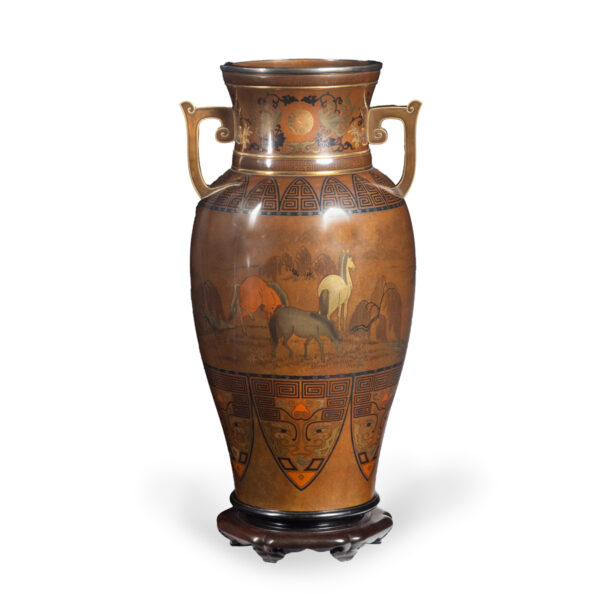
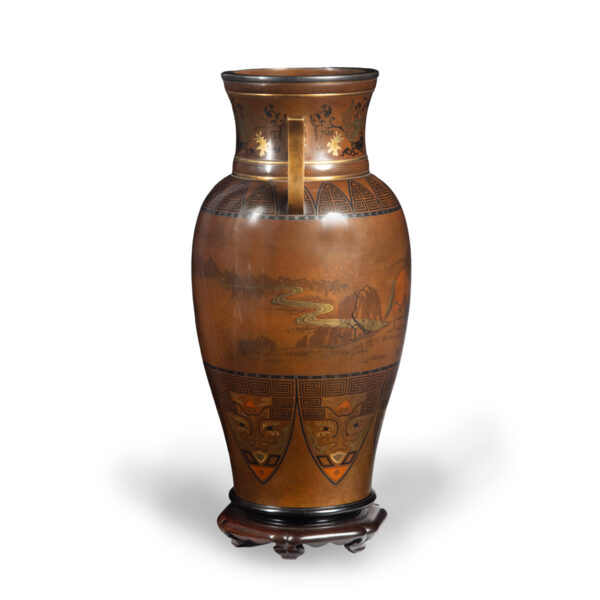
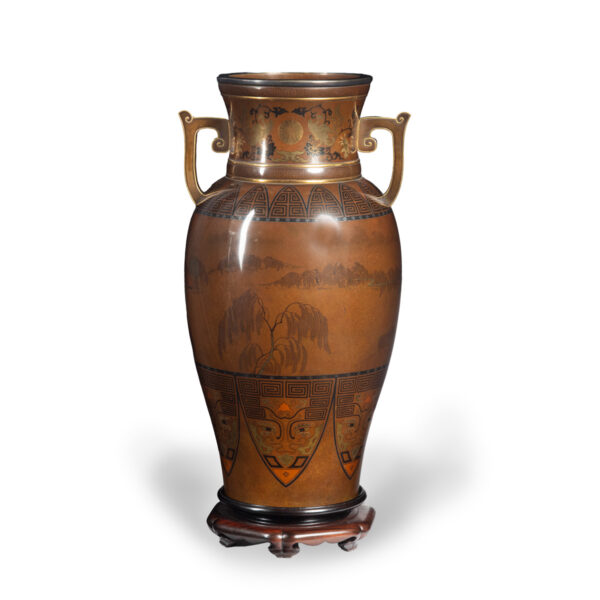
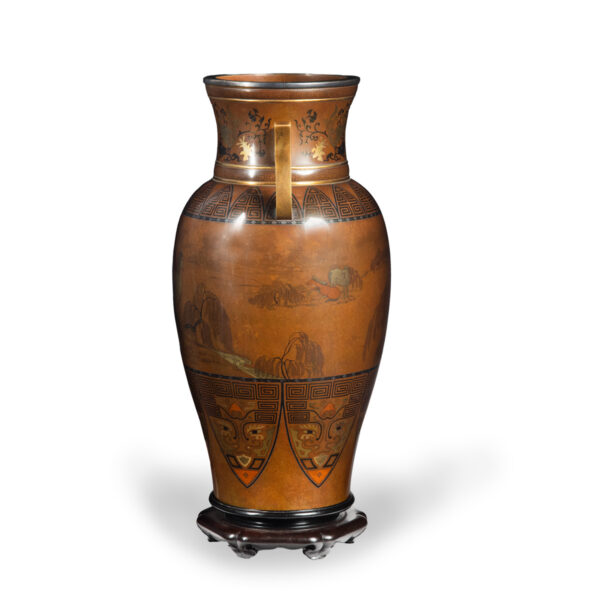
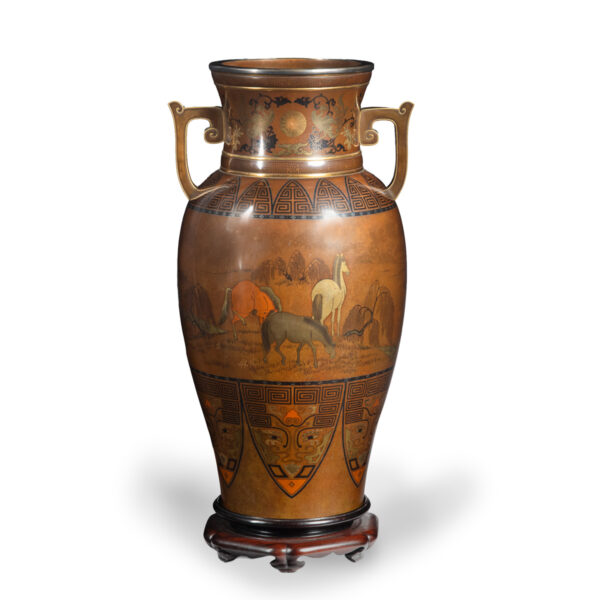
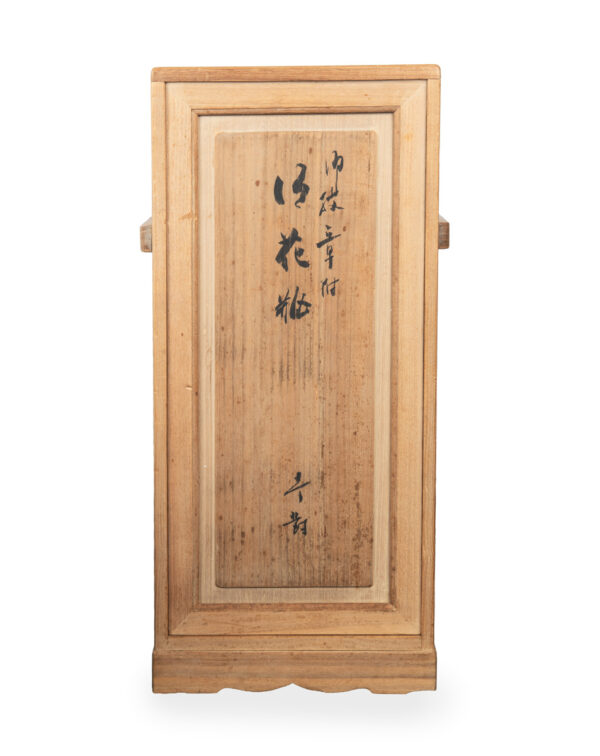
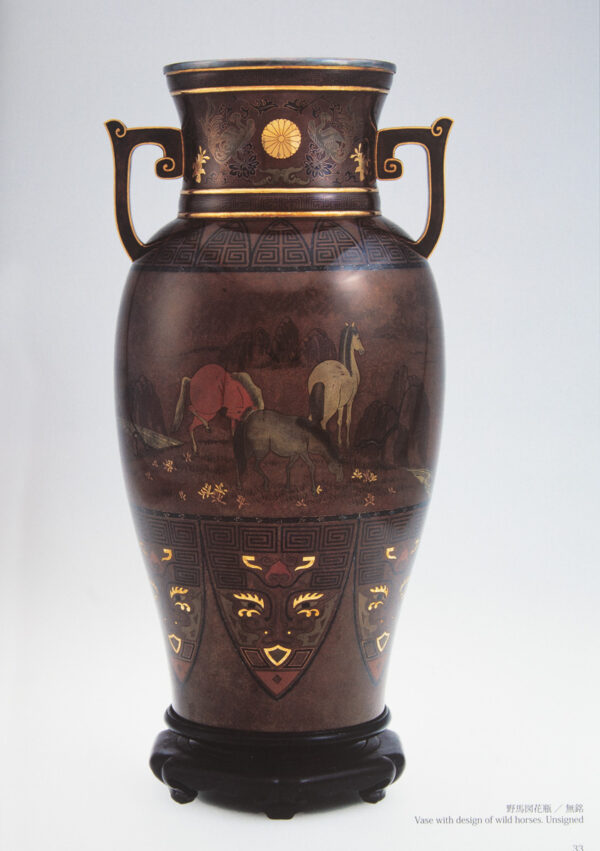
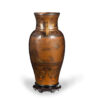
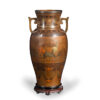
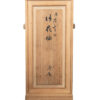
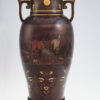

As part of our Japanese works of art collection we are delighted to offer this most unusual subject mid Meiji Period (1868-1912) bronze and mixed metal Kanazawa school vase. The baluster shaped vase is decorated with the most unusual subject of three horses of differing alloys grazing and frolicking in a field surrounded with willow trees, this magical scene continues throughout the central band with further horses at rest and willows hanging over a meandering stream. The entire central band executed to an incredible standard of mixed metal inlays in the manner of an earlier Edo period ink and gouache scroll painting. By contrast, the area beneath houses a band of geometric lappets each decorated in mixed metal inlays of gold, shakudo and shibuichi of varying colours, each lappet portraying a mythical stylised face, the shoulders further decorated with shakudo coloured geometric lappets. A pair of side handles give rise to the neck rim which houses a scene of opposing mythical birds amidst trailing flora either side of the gold imperial presentation chrysanthemum (Kiku Mon), this scene adorned with gold and geometric banding beneath the shakudo top rim. Although unsigned, as is often the case with Imperial presenation gifts, there is no doubting the skill and craftsmanship in the manufacture of this vase, undoubtably manufactured by one of the kanazawa school artists of the middle Meiji Period between 1877 and 1888 . A vase deemed worthy of Imperial presentation during that earlier period of production and understandably so. The vase comes complete within its original Tomobako upon which the inscription rather confusingly suggests this was a pair of Imperial Presentation vases , its hardwood stand fits inside that box and I have little doubt it is original to the vase.
Provenance :
Private Owner Museum Collection. Kiyomizu Sannenzaka Museum, Kyoto, Japan.
Exhibited :
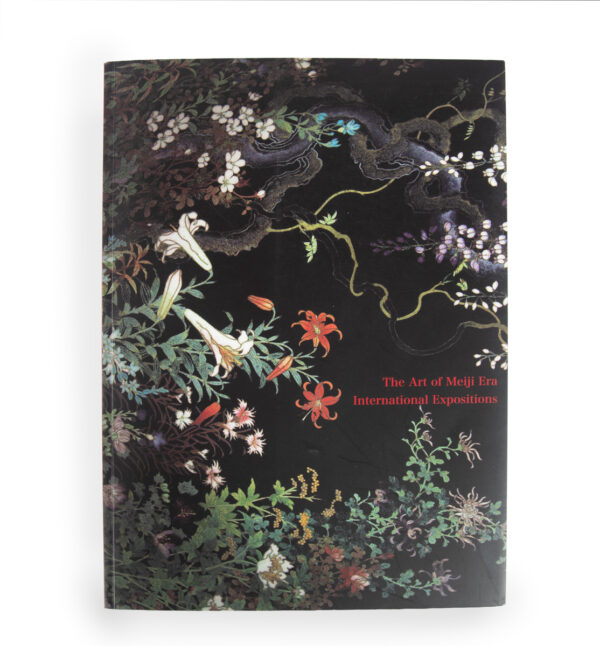
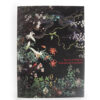
This vase featured in the “Art of Meiji International Expositions” Publication and exhibition: February 26, 2010 – May 23 , 2010. The Kiyomizu Sannenzaka Museum. Under the Supervision of Mr Masayuki Murata.
Literature :
In 1877 the Kanazawa Doki Kaisha (金沢銅器会社) was established in Naga-machi, Kanazawa-ku, Ishikawa-prefecture with the aim of assisting metalworkers and exporting new products overseas.
Koji Yamakawa (山川孝次 1828-1882) was born in Kanazawa. He changed his name fro Yasokichi Yamaya 山屋八十吉 to Koji Yamakawa around early 1860s. He apprenticed to Harushige Yanagawa (柳川春茂) who belonged to a school of famous Soumin Yokoya (横谷宗珉) in Edo, He was called “Kaga Soumin (加賀宗珉)” because he rapidly acquired the skills and presented it on his works.
In 1862 he was employed as a official silversmith (白銀師) by the Kaga domain (加賀藩) .
He called on finest artisans in the Kaga domain for the exhibition Vienna World’s Fair 1873, who would have sufficient skills as a chief of workers (棟取). The list was as follows;
Yamao Jiroku 山尾次六
Genroku Mizuno 水野源六光春 (1835-1895)
Chuzou Hiraoka 平岡忠蔵
Kahei Suzuki 鈴木嘉平
After the exhibition, by the Meiji government’s order, they founded the company “Doki Kaisha
銅器会社” (later renamed “Kanazawa Doki Kaisha 金沢銅器会社”, under the president Jyunnya Hasegawa 長谷川準也, in 1877.
Kouji Yamakawa (山川孝次) worked as a chief (棟取) in Doki Kaisha and won a prize at Centennial Exposition (Philadelphia Expo) in 1876, the highest prize 鳳紋賞牌 at the first national exhibition (第一回内国勧業博覧会) in 1877. Magohei Maruyama
圓中孫平, the export merchant commissioning to Yamakawa, also won a prize 龍紋賞牌 at the first national exhibition and a Gold medal at Paris Expo in 1878. @ QUOTE https://cefiro.main.jp/Other_Japanese_Makers.html The Company closed in 1888.
Provenance :
Private Owner Museum Collection.Kyoto, Japan.
Condition report :
Super condition with minimal age related wear.
Approximate Sizes :
Height : 16 1/2″ 42 cm
Width : 8 1/2″ 21.5cm
Free worldwide delivery and a certificate of authenticity are included within the price of this item.